
How to Find Nueces County Arrest Records
Arrest information sits with the agency that made the arrest and the jail that booked the person. The Nueces County Sheriff's Office runs the county jail at 901 Leopard Street and can be reached at (361) 887-2222. The county did not publish an open, searchable jail roster in its official pages, so current custody and recent booking details often come from a direct call or a records request to the jail.
For a person's full criminal history, the state is the source. The Texas Department of Public Safety keeps the statewide criminal history record. To trace a charge to its case, move to the court records once the case is filed.
- Identify the arresting agency, such as the Sheriff's Office or Corpus Christi police.
- Call the Nueces County Jail at (361) 887-2222 for current custody status.
- Use the Texas DPS Criminal Records Service for a statewide history.
- Search the Nueces County court records once a case has a number.
- Check the warrant records page if no arrest has happened yet.
Arrest Record vs Criminal Court Record
An arrest record and a criminal court record are not the same file. One belongs to law enforcement; the other belongs to the courts. Knowing the difference tells you which office to contact for a Nueces County arrest records search.
| Feature | Arrest Record | Criminal Court Record |
|---|---|---|
| Held by | Sheriff or police agency | District Clerk or county courts |
| Covers | Booking, charges at arrest, jail status | Filings, pleas, disposition, sentence |
| Starts | At the time of arrest | When the case is filed in court |
| Where to look | Jail contact, DPS history | Court records and dockets |
What a Nueces County Arrest Record Shows
A booking record captures the basics of an arrest. It usually lists the person's name and booking details, the charges at the time of arrest, and bond information once a magistrate sets it. Felonies head toward district court, while misdemeanors land in the county courts at law.
- Name and booking or jail identification number.
- Arrest date and arresting agency.
- Charges and the statute or class at arrest.
- Bond type and amount once set.
- Court assigned after charges are filed.
Charges vs Convictions
This difference matters most. A charge is an accusation. A conviction is a finding of guilt by plea or verdict. Many arrests never become convictions. Cases get dismissed, reduced, or end in deferred adjudication, which is supervision that can keep a final finding off the record. Reading an arrest record alone can mislead, so always trace the charge to its court outcome.
| Point | Charge | Conviction |
|---|---|---|
| Meaning | The state accuses a person | A plea or verdict finds guilt |
| Proof of guilt | No | Yes |
| Where it shows | Arrest and booking record | Court disposition |
The 105th Judicial District Attorney, James "Jimmy" Granberry, prosecutes felony cases for the state in Nueces County. Governor Abbott appointed him in 2023, as the state appointment notice shows below.
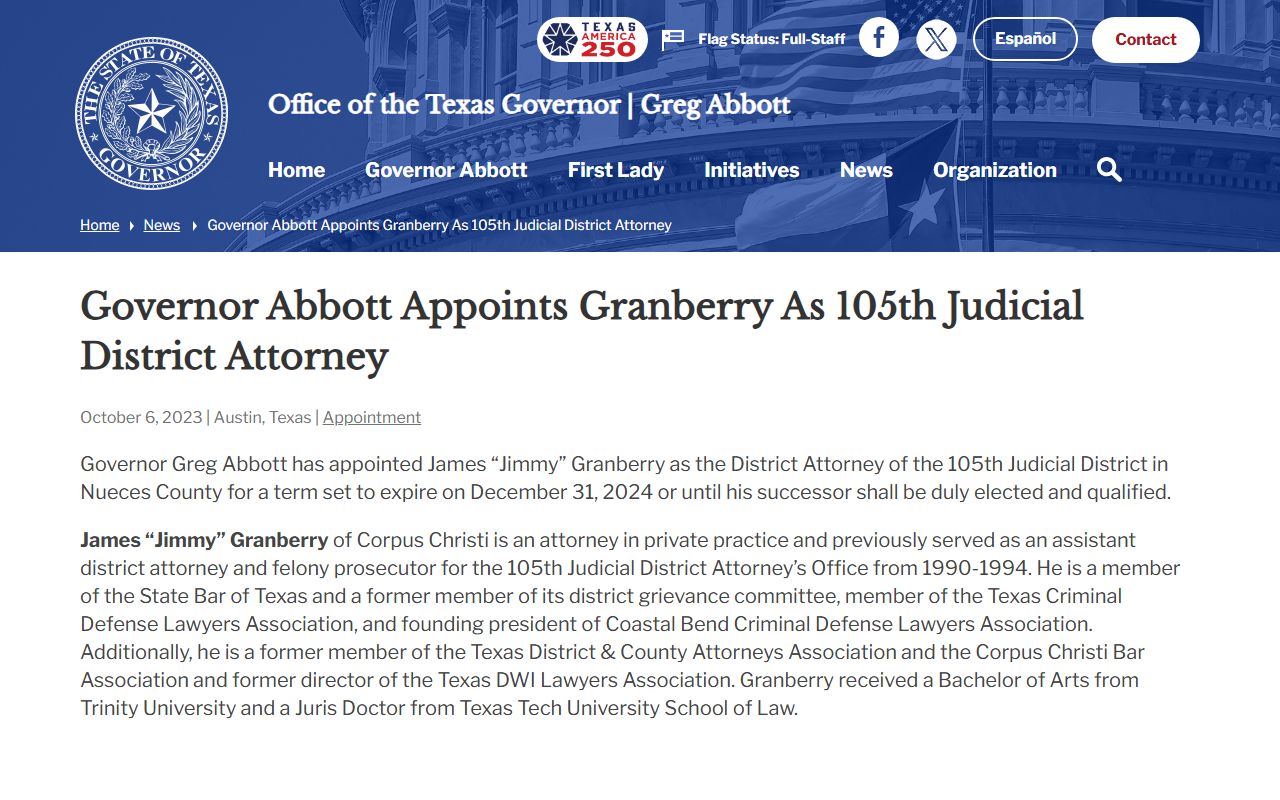
The District Attorney decides charges, presents cases, and recommends sentencing, which is why arrest charges and final court outcomes can differ.
Mugshots and Public Access
A booking photo is part of the arrest record, but Nueces County does not run a public mugshot gallery in the pages reviewed. Avoid private mugshot sites, which often charge to remove photos and are not official. For any verified booking image, the Sheriff's Office is the proper source.
Some details in an arrest record are protected. Driver license numbers, Social Security numbers, and victim information are not for public display under Texas privacy rules.
Federal Arrests and Cases
Not every arrest is a county matter. Federal agents make arrests for drug, firearm, immigration, and fraud cases, and those move through federal court. Nueces County falls in the U.S. District Court for the Southern District of Texas, with a Corpus Christi Division. The U.S. Attorney prosecutes those cases.
The screenshot is from the U.S. Attorney's Office for the Southern District of Texas, which handles federal prosecutions touching Nueces County.

Federal custody is tracked through the Bureau of Prisons, not the county jail. The released inmates page covers that locator.
Sealed vs Expunged Records
Texas offers two ways to limit an old arrest record, and they are not the same. Expunction destroys eligible records. Nondisclosure, often called sealing, hides the record from the public while keeping it available to justice agencies. The table sorts the two.
| Point | Expunction | Nondisclosure (Sealing) |
|---|---|---|
| Statute | Code of Criminal Procedure § 55A | Government Code § 411 |
| Effect | Records destroyed | Hidden from public, kept by agencies |
| Public access | None after order | Limited to justice agencies |
The Nueces County District Clerk runs an expunction information page that lists the agencies a petitioner may need to serve, updated for a state law that took effect September 1, 2025. See the public records page for more on access rules.
Restricted Juvenile Records
Juvenile arrest and case records are closed to the general public. Texas Family Code Chapter 58 restricts juvenile records and the juvenile justice information system. Access is limited to the juvenile, parents or guardians where allowed, attorneys, and justice agencies. Do not expect an adult arrest or court search to display juvenile details.
Indigent Defense and the Public Defender
Anyone arrested has the right to counsel. Nueces County uses both court-appointed private attorneys and a Mental Health Public Defender's Office, created in 2022 with a Texas Indigent Defense Commission grant. The office adds social workers and an investigator so it can address the whole person behind a charge.
The Texas Indigent Defense Commission, shown below from its official site, funds and oversees indigent defense across the state, including in Nueces County.

Defendants do not pick the public defender directly. The court assigns counsel based on eligibility and a rotation.